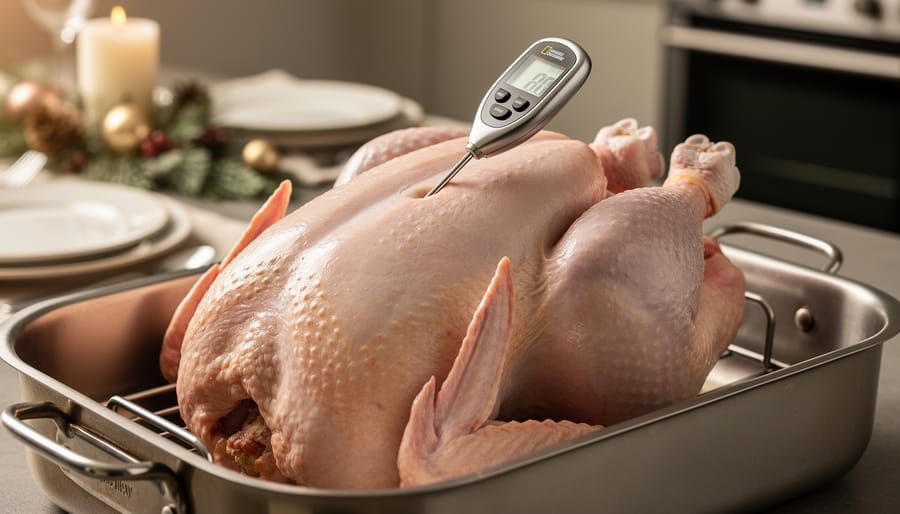
Cooking a turkey takes roughly 15 minutes per pound at 325°F (163°C), which means a 12-pound bird needs about three hours in the oven. That simple formula is your starting point for holiday meal planning, but the real measure of success isn’t the clock on the wall, it’s hitting an internal temperature of 165°F (74°C) measured at the thickest part of the breast and thigh. Get that right, and you’ll serve a perfectly cooked turkey every time.
The stakes matter more than you might think. Undercooked turkey poses serious food safety risks, while overcooking turns an expensive centerpiece into dry, disappointing leftovers. Canadians waste significant amounts of holiday turkey each year due to timing mishaps, whether it’s throwing out undercooked portions that can’t be saved or watching guests pick around meat that’s been roasted into sawdust.
Understanding the basic calculation gives you control over your holiday timeline, but you’ll need to adjust for variables like stuffing, oven accuracy, and whether your bird started frozen or fresh. A meat thermometer eliminates the guesswork and protects both your family’s health and your food budget. The 15-minute rest period after roasting isn’t optional, it allows juices to redistribute throughout the meat and raises the internal temperature by another few degrees, ensuring safety without sacrificing tenderness.
What You Need to Cook Turkey Safely
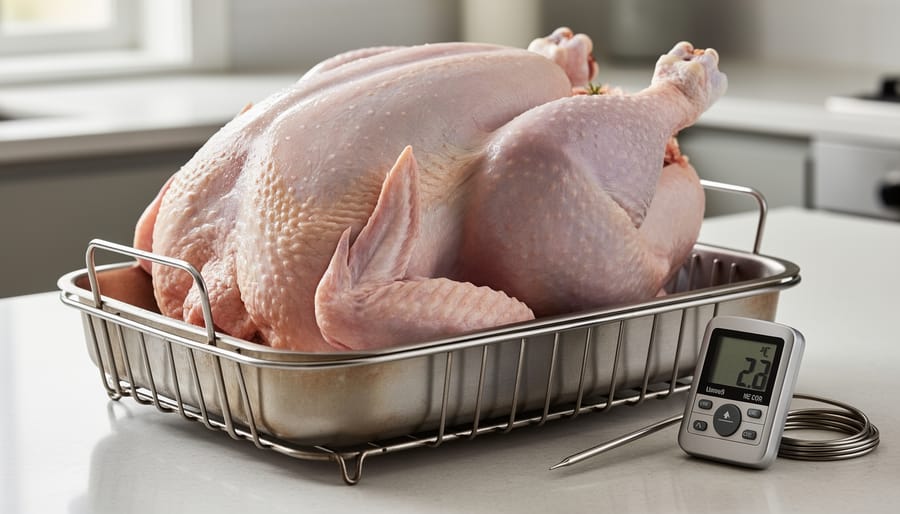
You’ll need just a handful of tools to cook turkey safely and avoid the twin pitfalls of food poisoning and dry, wasted meat. The right equipment takes the guesswork out of timing and ensures your bird turns out moist, safe, and delicious every time.
Here’s what you need:
- Meat thermometer (digital instant-read strongly recommended), the single most important tool for safety and quality
- Roasting pan with a raised rack to allow even heat circulation
- Aluminum foil for tenting if the skin browns too quickly
- Oven mitts rated for high temperatures
A reliable meat thermometer isn’t optional. Guessing doneness by appearance, cooking time alone, or the “jiggle test” leads to two costly mistakes: undercooked turkey that poses serious health risks, or overcooked turkey that’s so dry your guests leave it on their plates. Both scenarios create unnecessary waste. Digital instant-read models give you an accurate temperature in seconds, letting you check multiple spots without losing oven heat.
The other tools support even cooking and safe handling. A roasting pan with a rack lifts the turkey above drippings so heat circulates underneath, helping you hit that target cooking time of 15 minutes per pound more reliably. Foil protects the breast if it’s browning faster than the thighs cook through, and proper oven mitts prevent burns when you’re wrestling a hot roasting pan.
Optional but helpful: a kitchen timer to track your estimated finish time, and a basting brush if you want to add moisture or browning during roasting. These extras are nice, but the thermometer is non-negotiable. It’s the difference between a turkey that’s perfectly cooked and one that ends up in the compost bin.
Critical Safety Guidelines Before You Start
Food safety isn’t just about preventing illness, it’s about preventing waste. When turkey is undercooked or mishandled, it must be thrown away, turning your holiday centrepiece into avoidable garbage. Before you start roasting, commit these four non-negotiable safety rules to memory.
First, your turkey must reach an internal temperature of 165°F (74°C) throughout. This Health Canada safe temperature standard applies to both Health Canada and USDA guidelines, and it’s the only reliable measure of doneness. Timing formulas help you estimate, but the thermometer has the final say.
Second, thaw your turkey completely before cooking. A partially frozen bird cooks unevenly, leaving cold spots where bacteria survive even when other parts seem done. Plan ahead: thawing in the refrigerator takes roughly 24 hours for every five pounds.
Third, Don’t wash raw poultry. Rinsing raw turkey splashes bacteria across your sink, counters, and anything nearby, it doesn’t make the bird safer, it contaminates your kitchen. Pat it dry with paper towels instead.
These precautions take minutes but protect both your family’s health and your food budget. A safely cooked turkey is one that gets eaten, not binned.
Step-by-Step: Calculating and Cooking Your Turkey
The Basic Formula: 15 Minutes Per Pound
The simplest way to estimate your turkey’s cooking time is the 15 minutes per pound guideline. Multiply your turkey’s weight by 15, and you’ll get a rough total in minutes. A 12-pound bird, for example, needs about 180 minutes, that’s three hours in the oven. For a 16-pounder, you’re looking at four hours.
Canadian cooks working in metric can use approximately 33 minutes per kilogram as the equivalent. A 5.5-kilogram turkey would take around 180 minutes using this conversion.
This formula gives you a solid starting point for planning your day, but treat it as an estimate rather than a fixed rule. Your actual cooking time shifts depending on how accurate your oven runs, whether your turkey starts at room temperature or fridge-cold, and if you’ve stuffed the cavity. A stuffed bird always takes longer because the dressing inside must also reach safe temperature. Think of 15 minutes per pound as your baseline, the thermometer will tell you when the turkey’s truly done.
Following the Cooking Process
Once your turkey is prepped and in the roasting pan, the actual cooking process is straightforward, but a few smart choices make the difference between a perfectly moist bird and one that dries out or cooks unevenly.
- Place the turkey breast-side up on a rack in your roasting pan. The rack allows heat to circulate underneath and prevents the bottom from steaming in drippings.
- Start roasting at a steady 325°F (163°C). Some recipes call for an initial blast at 450°F to brown the skin, but this approach often dries out the breast meat before the thighs finish cooking, creating waste you could avoid.
- If the breast or wing tips start browning too quickly (usually after the first hour), loosely tent those areas with aluminum foil. Remove the foil for the final 30 minutes to crisp the skin.
- Check the internal temperature starting about 30 minutes before your calculated time is up. Insert your thermometer into the thickest part of the thigh without touching bone, it should read 165°F (74°C).
Basting can add flavour, but here’s the trade-off: every time you open the oven door, you lose heat and add roughly 10 to 15 minutes to your cooking time. If you do baste, limit it to once every 45 minutes rather than every 20. Many experienced cooks skip basting entirely and get excellent results by simply brushing the turkey with butter or oil before it goes in.
The key is patience and temperature monitoring. Your turkey will tell you when it’s ready, trust the thermometer, not just the clock. Once it hits 165°F throughout, you’re done.
Adjusting for Stuffed vs. Unstuffed Birds
Stuffed turkeys take longer to cook, plan on roughly 15 to 20 minutes per pound instead of the standard 15 minutes. The challenge isn’t just the bird reaching 165°F; the center of your stuffing must also hit that same safe temperature. Many home cooks end up with dry, overcooked turkey while waiting for the stuffing to catch up.
Here’s a better approach: cook your stuffing separately in a casserole dish. You’ll have complete control over both components, the turkey stays juicier, and you won’t risk undercooking the stuffing. This also means less chance of dried-out meat ending up in the compost bin because you played it safe with timing. If you prefer traditional in-bird stuffing for presentation, stuff loosely and check both the thigh and the stuffing’s center with your thermometer before pulling the turkey from the oven.
How to Know Your Turkey Is Done (and Won’t Go to Waste)
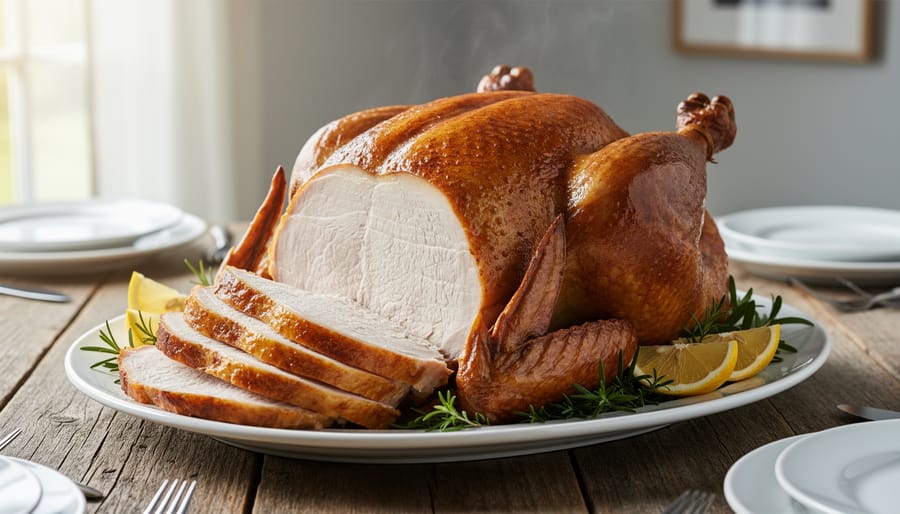
The most reliable way to confirm your turkey is done is to check its internal temperature with a meat thermometer. Insert the probe into the thickest part of the thigh without touching the bone, this area takes longest to cook and must reach 165°F (74°C). Check the thickest part of the breast and the innermost part of the wing as well. All three spots need to hit that safe minimum temperature before you can safely remove the bird from the oven.
Visual cues can back up your thermometer reading, but never rely on them alone. When your turkey is fully cooked, the juices should run clear when you pierce the thigh, and the drumstick should wiggle freely in its socket. The skin will be golden brown, though colour alone doesn’t guarantee doneness.
That resting period isn’t just about temperature carryover. When you cut into turkey immediately after removing it from the oven, the juices run out onto the cutting board instead of staying in the meat. A rested turkey stays moist, tastes better, and looks more appealing on the plate, which means people actually want to eat it and finish their portions rather than leaving dry slices behind.
If your thermometer shows the turkey hasn’t reached 165°F yet, simply return it to the oven and check again every 15 minutes. If you’ve overcooked it and the meat is dry, don’t toss it. Shred the driest portions for turkey soup, casseroles, or pot pies where they’ll absorb moisture from other ingredients. Even overcooked turkey has value when used creatively.
Reducing Turkey Waste Beyond Cooking Time
Nailing the cooking time isn’t just about serving a safe, juicy bird, it’s the foundation of a zero-waste holiday. When turkey is cooked properly, people actually want to eat it, and leftovers become an opportunity instead of a chore. Understanding how food waste harms the planet makes these small choices matter more. A perfectly roasted turkey transforms into sandwiches, soups, and casseroles instead of ending up in the bin.
Beyond timing, a few practical steps can help you save food from wasting this holiday season:
- Buy the right size bird, plan for 1 to 1.5 pounds per person to avoid massive excess
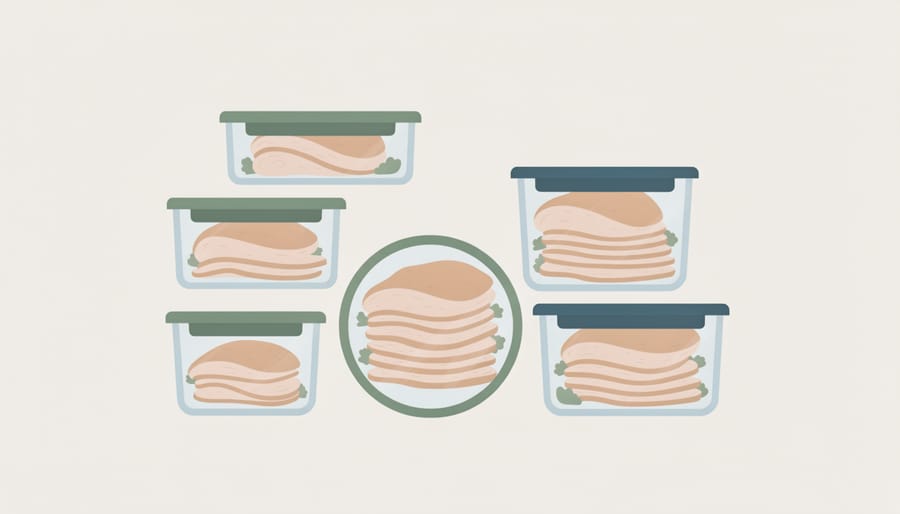
- Store leftovers within two hours in shallow containers so they cool quickly and stay safe
- Freeze extra turkey in portions within three days for easy future meals
- Save the carcass for rich homemade stock that reduces waste and adds flavour to winter cooking
Getting creative is easier when the meat is moist and appealing. There are countless ways to use turkey leftovers think turkey pot pie, grain bowls, or simple next-day sandwiches. The real win? When you cook it right from the start, those leftovers taste good enough that everyone actually eats them. That’s how proper timing connects to a sustainable kitchen.
Common Questions About Turkey Cooking Time
Cooking turkey raises plenty of questions, especially when you’re preparing a holiday meal for family and friends. Here are answers to the most common timing concerns Canadian home cooks ask.
Does cooking time change at higher altitudes?
Yes, at elevations above 3,000 feet, your turkey may take longer to cook because water boils at lower temperatures, affecting heat transfer. Add roughly 25% more time and always verify doneness with a thermometer reading 165°F/74°C.
Can I cook turkey from frozen?
You can, but it will take about 50% longer than a thawed bird, and you cannot stuff it. The safest approach is complete thawing in the refrigerator beforehand, which gives you better control over cooking time and texture.
Why does my turkey always cook faster or slower than the guideline?
Oven temperature accuracy varies widely between models, and factors like turkey starting temperature, pan material, and how often you open the oven door all affect timing. This is why a meat thermometer is essential, the 15-minutes-per-pound formula is a helpful starting point, but internal temperature is your true measure of doneness.
Should I trust pop-up timers?
Pop-up timers can be unreliable and often trigger at temperatures higher than necessary, leading to overcooked, dry meat. Use your own instant-read thermometer to check multiple spots and confirm the turkey has reached 165°F/74°C throughout.
For convection ovens, reduce the standard roasting temperature by 25°F or shorten cooking time by about 25%, as the fan circulates heat more efficiently. Start checking temperature earlier than you would in a conventional oven. Remember, these adjustments still require thermometer verification, no calculation replaces actually measuring doneness. The goal is juicy, safe turkey that people will enjoy eating, not food that ends up wasted because it was guessed instead of tested.
Mastering turkey cooking time doesn’t have to be complicated. Remember the formula: 15 minutes per pound, cook to 165°F, then rest for 15 minutes before carving. This simple approach protects your family’s health while ensuring tender, flavourful meat that people actually want to eat. When your turkey turns out perfectly cooked, you’ll find fewer leftovers languishing in the fridge and more satisfied guests around your table. Getting the timing right is one of the easiest ways to stop wasting food at home especially during the holidays when expectations run high and budgets feel stretched. You’ve got the knowledge now, approach your next turkey with confidence, knowing you’re making choices that honour both the food and the resources that went into producing it.